Solutions for Financial Services

Every day, financial services firms face new challenges to their business models. The importance of trading profits as a financial mainstay, increasingly complex asset classes, and fragmentation of trading markets all present moving targets and demand fast changing analyses and forecasting techniques. At the same time, the growth in data volumes threatens to overwhelm computing capabilities. For example, current estimates indicate that algorithmic trading will drive the volume of market data messages from 8 billion per day in 2007 to 128 billion per day by 2010!

Financial Services Face Daunting Computing Challenges

The above trends, which alone are daunting to IT managers, are further magnified by the enormous pressure to create faster and better computing solutions to keep ahead of the competition. Developers are striving to wring out every microsecond of latency and to maximize application throughput. Over the past few years, the decline in exponential growth of CPU speed has exacerbated the problem, but it has also stimulated resurgence in the use of high performance computing (HPC) grids, which have provided important performance gains for developers to leverage. This has resulted in the rapid adoption of grid computing by financial services firms.

The gains in HPC have clearly helped, but they have led architects and developers to discover that their data access technology is now the bottleneck in grid computing environments. Application data used in grid computing today is typically maintained in a database until needed by the compute grid and is often delivered sequentially to the grid by a master control node. Even interim calculation results are frequently stored in a database. These traditional storage techniques drastically and unnecessarily lengthen overall compute time.

Distributed Data Grids Provide Performance and Productivity Breakthroughs

ScaleOut StateServer's distributed data grid provides important benefits to HPC applications in two significant ways. First, it boosts application performance and avoids traditional data storage limitations by reliably staging application data in memory within the compute grid's memory, making it simultaneously available to all compute nodes with very low latency. This storage breakthrough is made possible by ScaleOut StateServer's fully distributed architecture, which ensures that all data is available from any host in the grid and that high availability of cached data is maintained. The result is many fewer round trips to the database and faster access to data at in-memory speeds. Distributed data grids let applications eliminate key performance and scalability bottlenecks so that full advantage can be taken of your existing investment in HPC infrastructure.

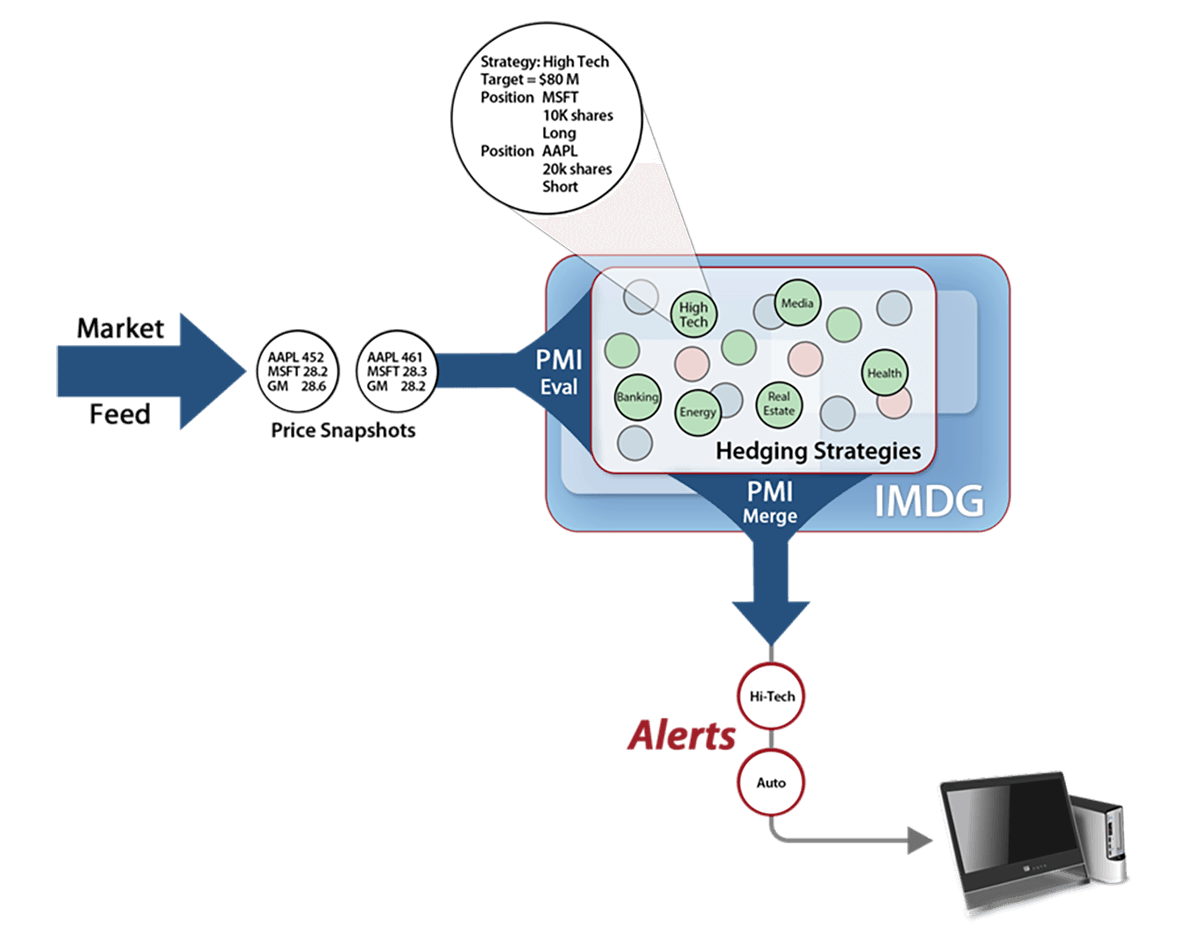
The second major benefit is even more exciting. Distributed data grids offer the opportunity to significantly simplify application structure and shorten development time. ScaleOut StateServer's ability to make cached data uniformly accessible on all compute nodes helps eliminate the need for developing complex, error-prone message-passing codes. This simplifies design and enables shorter development cycles. Advanced capabilities, such as ScaleOut StateServer's parallel queries, parallel method invocation, and parallel backup/restore, let applications perform a computation on cached data in parallel across all nodes and then automatically merge the results for reporting. These techniques can eliminate the complexity in many of today's solutions, which take the approach of manually dividing up compute tasks, and they deliver high performance and scalability. For example, a large set of portfolios cached in the compute grid could be simultaneously analyzed and the results efficiently combined into a final results set. ScaleOut StateServer's dynamic load-balancing distributes data uniformly across the grid to ensure high performance and scalability in these parallel computations.

The following diagram illustrates how distributed data grids speed up grid computing by moving data from the database onto the compute grid and by simplifying task scheduling by enabling parallel method invocations on cached data:

ScaleOut StateServer can be combined with other products to create an overall solution. This makes it a very flexible component of a wide variety of grid computing environments. For example, ScaleOut StateServer can be used to stage data read from SQL Server or to hold computational results awaiting merging and long term storage. ScaleOut StateServer also complements the Windows Compute Cluster Server job scheduler and third party task dispatchers, such as Digipede.

ScaleOut StateServer's distributed data grids can provide significant value in any grid computing environment in which faster data access by applications would be beneficial. Popular examples of financial services applications which can benefit from distributed data grids include:

Whatever the grid computing needs you have, ScaleOut Software can help deliver the high performance and scalability you need. Please contact us to discuss how your application can benefit from ScaleOut StateServer's industry-leading distributed data grid solutions.

Shorten time to insight with parallel data analysis

Case Study


Please download our exciting new case study that uses ScaleOut StateServer Grid Computing Edition's new parallel method invocation feature to speed up a real-life financial services application. The results are significant.

Companies Using ScaleOut

Our CustomersOur CustomersOur CustomersOur CustomersOur CustomersOur CustomersOur CustomersOur CustomersOur CustomersOur CustomersOur Customers

Certification & Partners

Share This Page