Cloud Computing

Grid computing in the cloud Cloud computing is quickly gaining popularity with companies in all industries. One of its primary benefits is on-demand elasticity to expand computing resources for peak loads. The ability to access additional computing resources when needed can enable enterprise IT departments to cost-effectively shift their focus from data center operations to higher-value activities. By dramatically simplifying and enhancing the deployment of scalable applications within cloud-based infrastructures, distributed data grids play a key role in delivering on this promise of on-demand elasticity.

Scalable Performance

Scalable applications hosted in the cloud need to eliminate performance bottlenecks so that they can take full advantage of the cloud's elastic resources. The use of a distributed data grid gives applications a scalable storage repository where data can be accessed without bottlenecks and shared across a pool of virtual servers. ScaleOut StateServer's architecture natively supports automatic expansion and contraction of its distributed data grid in response to application requirements. As servers are added, the grid automatically scales, and applications benefit from linearly increased throughput on demand. When no longer needed, grid servers can be removed and data gracefully compacts into the remaining servers. The distributed data grid's natural elasticity fully complements the cloud's ability to supply elastic resources in response to the needs of applications.

Scalable Performance


Transparent Data Migration

Distributed data grids can also significantly reduce the complexity of migrating applications to the cloud, which helps both enterprise IT managers and third-party cloud providers meet the stringent performance and uptime needs of cloud deployments. ScaleOut StateServer enables data grids at different sites to be integrated into a single logical, uniform, and coherent distributed data grid. ScaleOut StateServer provides a "bridge" to the cloud, automatically migrating data between on-premise and cloud environments as needed. By making data seamlessly available regardless of location, ScaleOut StateServer avoids the need for applications to manually restage grid data into a separate cloud-based store. Applications benefit from a seamless transition of data into the cloud (or within the cloud across application instances) to take full advantage of its resources.

For example, consider a premise-hosted ecommerce Web farm that needs to scale into the cloud to handle high seasonal demand. To accomplish this, the Web site's IP load-balancer can be configured to distribute web requests across both on-premise and cloud-based Web servers. By using ScaleOut StateServer's distributed data grid, all of the site's Web servers can seamlessly share session data within a single, logical, data grid; migration of session data into and out of the cloud is automatically managed by the grid without the need for explicit restaging by IT administrators.

Parallel data analysis


Data Analysis

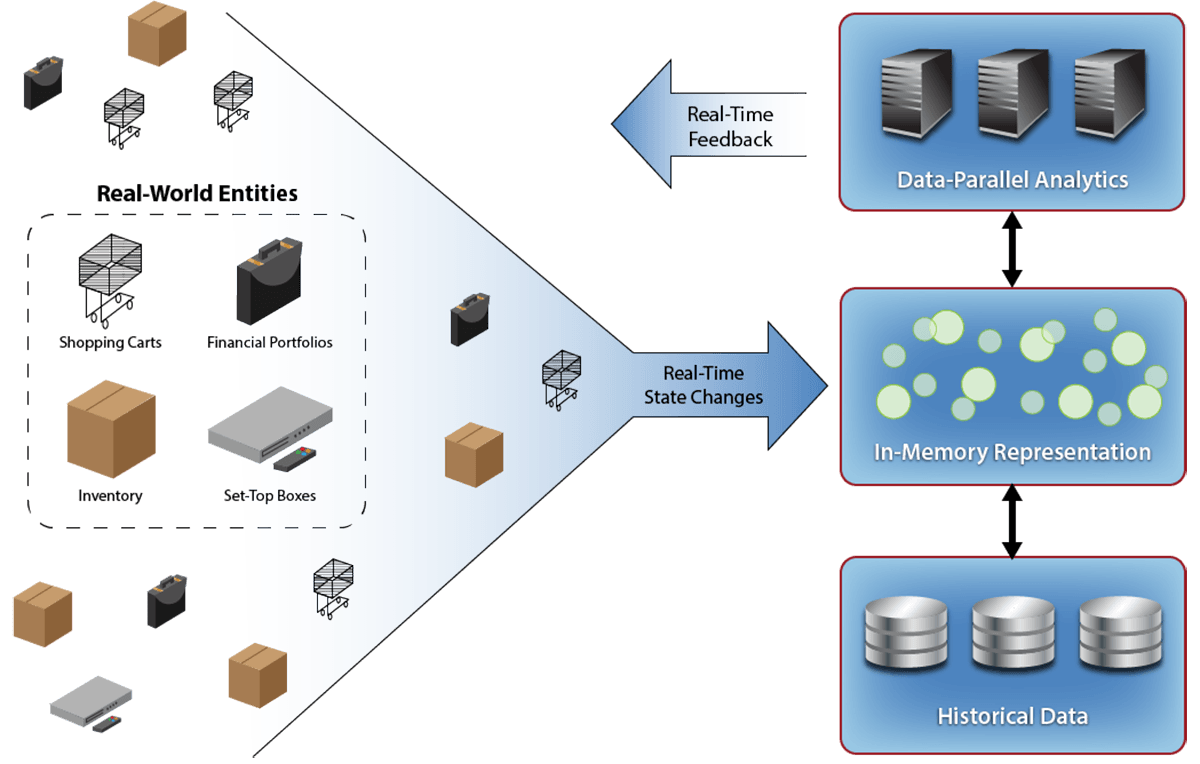
In addition to automatic scalability and transparent data migration, distributed data grids open the door to performing powerful data analysis within the cloud. High performance computing (HPC) environments routinely process computational analyses of large data sets, such as stock price/volume histories, retail transactions, census data, and many others. A cloud-based distributed data grid provides the perfect platform for such analyses since a large number of servers can be employed for only the time needed, not as a permanent investment.

ScaleOut StateServer Grid Computing Edition incorporates important capabilities for performing data-parallel analysis in the cloud. By employing the popular "map/reduce" programming model, ScaleOut StateServer delivers fast, scalable performance with low development cost and fast turnaround time. The distributed data grid's use of function shipping to efficiently implement parallel analysis of grid data also overcomes the bandwidth limitations of typical cloud networks. These breakthroughs enable distributed data grids to take full advantage of the economic benefits offered by clouds.

Benefits for Cloud Infrastructure

Distributed data grids are useful for many operations associated with maintaining the cloud's infrastructure. The in-memory and distributed nature of a data grid makes it useful for holding a wide range of infrastructure data. For example, grid-based storage of virtualization parameters can speed the performance of cloud provisioning and operations, such as virtual server migration. Usage statistics efficiently can be maintained in the grid for billing purposes. Also, performance data for the cloud itself can be stored in a distributed data grid for instant detection of issues or for optimization purposes.

Take full advantage of elastic computing in the cloud

Companies Using ScaleOut

Our CustomersOur CustomersOur CustomersOur CustomersOur CustomersOur CustomersOur CustomersOur CustomersOur CustomersOur CustomersOur Customers

Certification & Partners

Share This Page